AI Chatbots for Business in 2026: How Small & Mid-Sized Companies Automate Support and Sales
A practical guide to implementing LLM-powered AI chatbots and intelligent customer agents — cost, tech stack, WhatsApp integration, and conversion ROI.
Quick answer
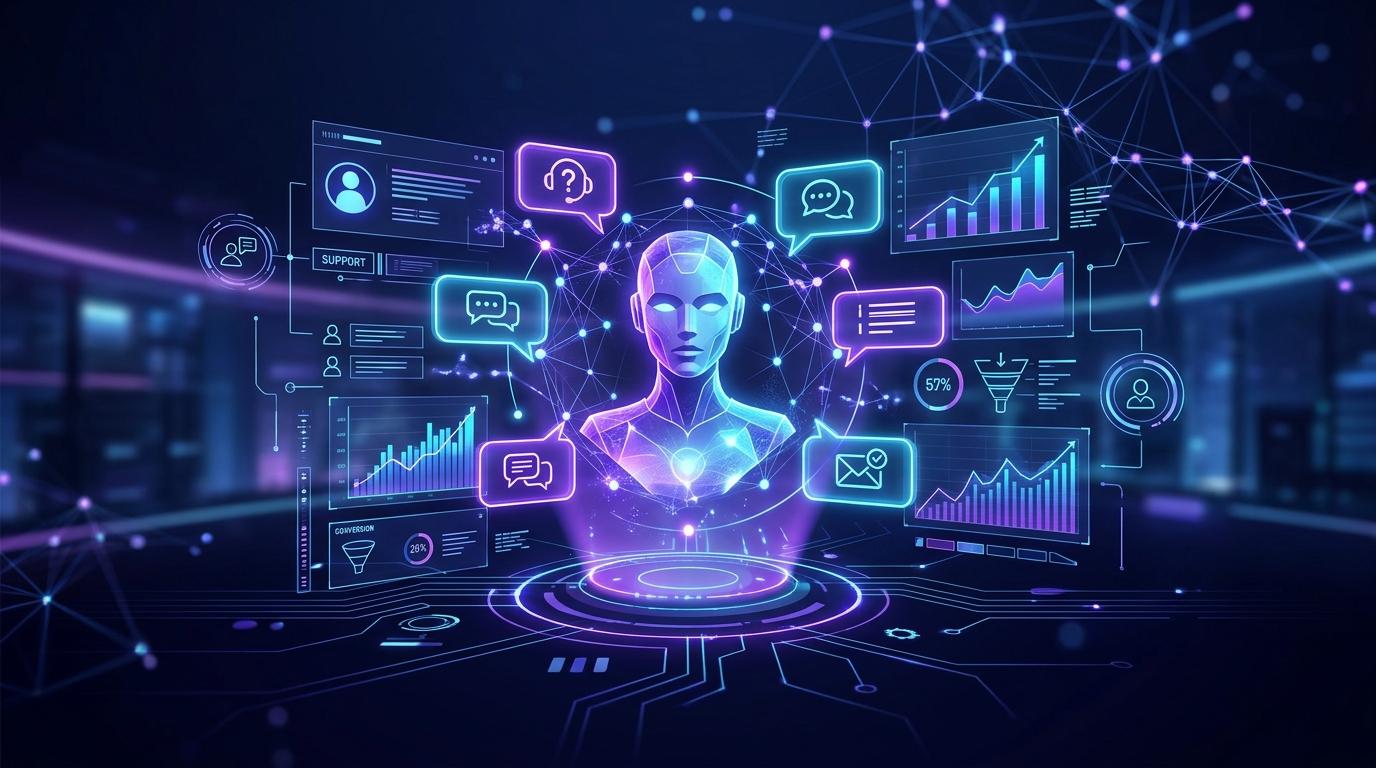
Modern AI chatbots powered by large language models like Google Gemini can resolve 70%+ of customer enquiries instantly, qualify leads 24/7, and connect directly to CRM, WhatsApp and email. Unlike rigid rule-based bots from five years ago, intelligent agents understand nuance, speak multi-lingual Hindi and English, and increase website conversion rates by 25–40%.
Key takeaways
- Rule-based bots frustrate visitors; LLM agents hold natural, context-aware conversations and resolve complex customer queries.
- Integrating your website chatbot with WhatsApp and email CRM ensures high-intent leads are captured immediately.
- Small and mid-sized businesses can launch a custom AI agent in under a week without costly enterprise licenses.
- Grounding the AI on your specific business knowledge base prevents hallucinations and ensures accurate pricing and policies.
Customer expectations have fundamentally transformed. When potential buyers land on your website at 10 PM, they don't want to wait 24 hours for an email response or fill out a tedious multi-field form. If they cannot get a fast, accurate answer about your pricing, services, or turnaround times, they simply leave and open your competitor's site. This guide shows how small and mid-sized companies automate support and sales with AI chatbots that answer instantly.
For years, website chatbots had a bad reputation. They were clunky, scripted decision trees that broke whenever a user typed something outside predefined options. In 2026, large language models (LLMs) such as Google Gemini and Anthropic Claude have changed everything. Today's AI agents understand nuance, handle multi-turn dialogue, speak multiple languages, and function as tireless 24/7 sales representatives.
Here is an honest, practical guide to implementing an AI chatbot for your business — without wasting money on overhyped enterprise tools.
Why traditional rule-based chatbots failed
Old chatbots relied on rigid if-else logic. If a user asked "What do you charge for a custom website?", a bot might succeed. But if the user asked "I run a boutique clothing store in Jaipur and need an online shop with Razorpay integration — what's the budget?", the bot would fail with: "Sorry, I didn't understand that. Please choose from the menu."
Modern generative AI chatbots do not match exact strings. They understand intent, extract key entities (business type, location, required features), and synthesize an accurate, personalized answer grounded in your company's actual service offerings.
Key capabilities of a modern AI agent
- Instant lead qualification: The AI greets visitors, asks qualifying questions (budget, timeline, project scope), and scores leads before handing them off to your sales team.
- Natural bilingual conversations: For businesses in India and global markets, the bot can effortlessly switch between English, Hindi, and colloquial Hinglish.
- Direct CRM & WhatsApp handoff: When a visitor expresses high buying intent, the bot collects their contact details and triggers a WhatsApp chat link or email notification in real time.
- Accurate knowledge retrieval: By connecting the LLM to your specific FAQs, portfolio, and service documentation, the AI acts with domain expertise rather than generic platitudes.
Preventing hallucinations: the secret to safe AI
The number one fear business owners have is that an AI bot might promise unrealistic discounts or give incorrect legal advice. In modern engineering, this is solved through two techniques:
- System prompt guardrails: Explicit system instructions define the persona, restrict the bot from inventing prices, and instruct it to politely request an email or WhatsApp connection for custom quotes.
- Context grounding: The model is fed verified knowledge snippets. If an answer cannot be found in your documentation, it gracefully says: "I want to make sure you get the exact details for your situation. Would you like our founder to reach out on WhatsApp?"
Step-by-step implementation roadmap
1. Audit customer queries: Collect the top 30 questions your sales and support teams answer every week. 2. Choose your model architecture: Lightweight models like Gemini 3.8 Flash provide sub-second latency and minimal inference costs. 3. Build the API integration: A secure backend route keeps your API keys secret, implements IP rate-limiting, and tracks conversations. 4. Connect WhatsApp and notifications: Ensure leads captured by the AI bot immediately alert your team via email or webhook. 5. Iterate weekly: Review chat transcripts to discover new questions your visitors are asking and continuously update your knowledge base.
Ready to automate your sales enquiries?
At Zynetechs, we build and deploy production-grade AI agents integrated directly into custom websites, WhatsApp, and CRM workflows. Book a free consultation to see a live demo tailored to your industry.
Frequently asked questions
Quick answers about ai & automation from the Zynetechs team.
Building a custom AI agent with modern LLM APIs (such as Gemini 3.8 Flash) is remarkably cost-effective. API inference typically costs a few pennies per hundred conversations. Upfront setup includes prompt engineering, knowledge base vector indexing, and CRM/WhatsApp integration, offering high ROI within the first month.