Google Ads vs Meta Ads in 2026: Where Should Indian & Global Businesses Spend Their Budget?
A direct comparison of Google Search & Performance Max vs Meta Instagram & Facebook ads — targeting, ROAS benchmarks, CPC trends, and the ideal budget split.
Quick answer
Spend on Google Ads when prospects are actively searching for your high-intent service or product right now. Spend on Meta Ads (Instagram and Facebook) to generate demand, tell visual stories, and target interest-based demographics. For most growing businesses, a 60/40 or 70/30 split between high-intent search and retargeting/social yields the highest blended ROAS.
Key takeaways
- Google Ads captures existing search intent; Meta Ads creates new demand and awareness.
- B2B services, emergency repairs, and high-ticket consulting win big on Google Search and Performance Max.
- D2C fashion, beauty, food, and consumer lifestyle brands achieve higher scale and lower CAC on Instagram Reels ads.
- First-party tracking (CAPI) and clean landing page conversion optimization are non-negotiable in 2026.
Every business owner asking "Where should I invest my marketing budget?" eventually faces the same showdown: Google Ads or Meta Ads (Instagram and Facebook)? Here is how Indian and global businesses should decide where to spend their budget.
Both platforms are digital advertising giants, but they operate on fundamentally opposite human psychology. Treating them the same is the fastest way to burn your ad budget with zero return. Here is how to evaluate each platform, understand real costs, and structure your budget for maximum profit in 2026.
Intent vs. impulse: the psychological difference
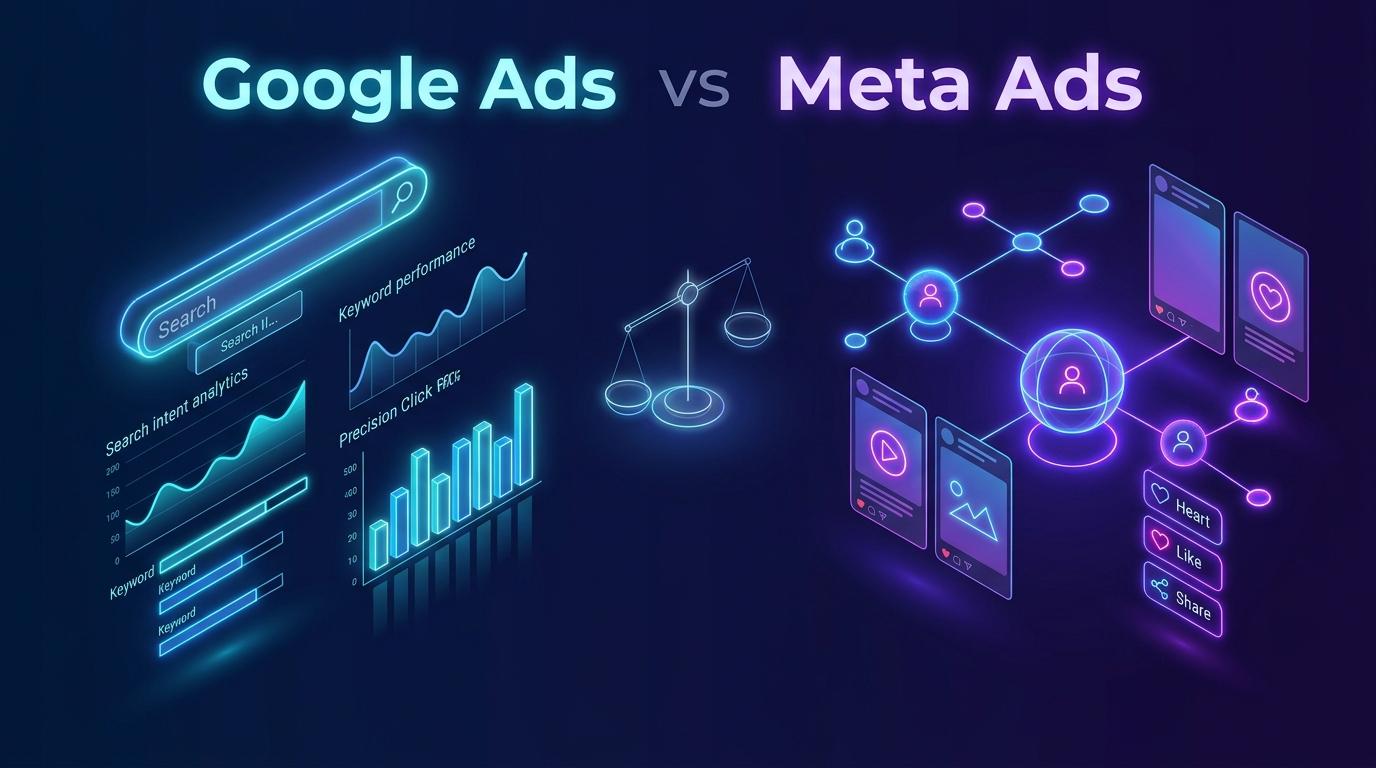
The core distinction between Google and Meta comes down to user intent:
- Google Ads is demand capture: People go to Google with a specific problem. They type "commercial solar panel installation Jaipur" or "emergency plumber near me" or "best Shopify agency". They already know what they want and are looking for someone to hire or buy from today.
- Meta Ads is demand creation: Nobody opens Instagram to look for an accountant. They open it to see friends, memes, and lifestyle content. Meta ads interrupt their feed with striking visuals, compelling hooks, and irresistible offers. You are creating desire where none previously existed.
When Google Ads wins
Google Ads is almost always the superior choice if:
- Your service has high urgency: Legal counsel, healthcare, plumbing, IT security, and B2B SaaS.
- Search volume is clear: People actively type the exact name of your product or solution into Google every day.
- Ticket sizes are high: When customer lifetime value is ₹50,000 to ₹5,00,000+ ($1,000 to $10,000+), paying ₹80 to ₹250 per click on exact-match search terms is mathematically very profitable.
When Meta Ads (Instagram & Facebook) wins
Meta Ads dominates when:
- Your product is highly visual: Fashion, luxury jewellery, interior design, packaged foods, cosmetics, and fitness.
- You are selling a new concept: If people don't know your product exists yet, they won't search for it on Google. You must show them via video reels and carousel ads.
- Impulse buying is high: Items priced under ₹3,000 ($50) convert exceptionally well on mobile social feeds.
- Retargeting past website visitors: Bringing back warm prospects who visited your site but didn't convert is significantly cheaper on Meta than anywhere else.
The ideal budget split: how to combine both
The most successful brands do not choose one over the other; they build an integrated funnel:
1. Top of funnel (60% on Meta or Google depending on category): Use Meta Reels or Google Search to bring qualified traffic into your ecosystem. 2. Middle of funnel (Retargeting on Meta): Show testimonials, case studies, and unboxing videos to people who visited your site in the last 30 days. 3. Bottom of funnel (Google Brand & Search): Capture the people who saw your social ads and later typed your brand name or exact service into Google.
Common pitfalls to avoid in 2026
- Neglecting page speed: A 3-second mobile load time causes 50%+ of ad clicks to bounce before the page even renders.
- Ignoring Conversions API (CAPI): With third-party cookies deprecated and ad blockers common, server-side tracking via Meta CAPI and Google Enhanced Conversions is mandatory for accurate attribution.
- Broad keyword waste: Never run phrase or broad match keywords on Google without a rigorous negative keyword list.
Stop guessing with your ad spend
Zynetechs manages high-performance Google and Meta ad campaigns focused on measurable revenue, transparent reporting, and lowering customer acquisition costs. Get in touch for a free audit of your current ad account.
Frequently asked questions
Quick answers about ppc & advertising from the Zynetechs team.
We recommend starting with at least ₹25,000 to ₹50,000 per month (or $1,000 to $2,000 internationally) to allow machine learning algorithms to exit the learning phase and optimize for conversions rather than random clicks.